 Donate
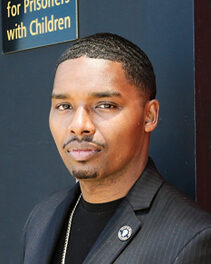
Paul Briley rose quickly in his leadership as an influential driver of the national network for All of Us or None and emerged as the first new Executive Director of Legal Services for Prisoners with Children in over twenty years. His ability to draw from the past and present, through a prism of historical roots that stretch across time—from the African diaspora unto the First Nations people and throughout the islands of Hawai’i—provides a powerful lens with which he interprets the annexation and criminalization of Black and indigenous cultural identity. He brings the nuanced experiences of his ancestry into his work that as he envisions a world without mass incarceration.
As a child, Paul was displaced by the foster care system and subsequently fell into a deep cycle of recidivism. He grew up in the Bayview-Hunters Point district of San Francisco, a community that has seen its fair share of social problems over the years. The juvenile dependency court deployed him to a highly structured boarding school for delinquent youth in the state of Iowa. After aging out of foster care, Paul became politicized through Project Rebound and learned how to use his carceral experience as a catalyst for change. He attended San Francisco State University and became an advocate for system-impacted students on campus. He transferred to the University of California, Berkeley and became a student ambassador for the Berkeley Underground Scholars, a student-led organization of formerly incarcerated students on campus working to expand the prison to school pipeline. He first joined LSPC in 2019 as a Ronald “Elder” Freeman Policy Fellow.
Through his time at LSPC, he has written landmark bill language and steered legislative victories. Now, he is looking toward the next era of LSPC and AOUON under his leadership. Paul also serves as the chair of the San Francisco Juvenile Justice Commission, which is critical to ensuring the safety and care of children who come into contact with the juvenile justice system. Paul’s leadership is deeply rooted in ancestral wisdom and his lived experience. He believes it is his life’s calling to critique and confront intergenerational apartheid and fight to protect and expand the rights of currently and formerly incarcerated people to end cycles of trauma. He embraces a revolutionary and unconventional vision for reentry that challenges outdated systems and redefines what it means to return to society. Paul has an insatiable appetite for resilient truth, obtaining knowledge that produces solutions, and creating ways to sustain institutional change.